
November 13, 2026
If you’re a brand deciding whether to hire outside help for influencer campaigns in the Philippines, the practical problem is usually not whether influencer marketing works. It’s figuring out which agency can actually run a campaign well, and whether their fees make sense for what you get.
Agencies in this space typically handle the full cycle of a campaign: strategy, finding and vetting creators, negotiating and contracting, briefing content, reviewing what creators produce, and reporting results. That full-service model exists because these tasks take specialized time and industry contacts that most internal marketing teams don’t have on hand, and managing them end to end reduces the workload on in-house staff.
The trade-off is straightforward: agency fees versus the value of creator access, execution capacity, and structured reporting. Some brands are fine handling parts of this themselves and only outsourcing creator sourcing or negotiation. Others want one partner managing everything.
This guide breaks down the core services these agencies offer, how pricing typically works, what a standard campaign process looks like, and questions worth asking before signing a contract, using Arc Innovation, a Philippine agency, as a working example along the way.

The specific mix varies by agency, but most PH agencies build campaigns around the same core components:

Before signing, ask which of these are actually bundled into the quoted fee. Reporting depth and paid amplification, in particular, are often billed separately.
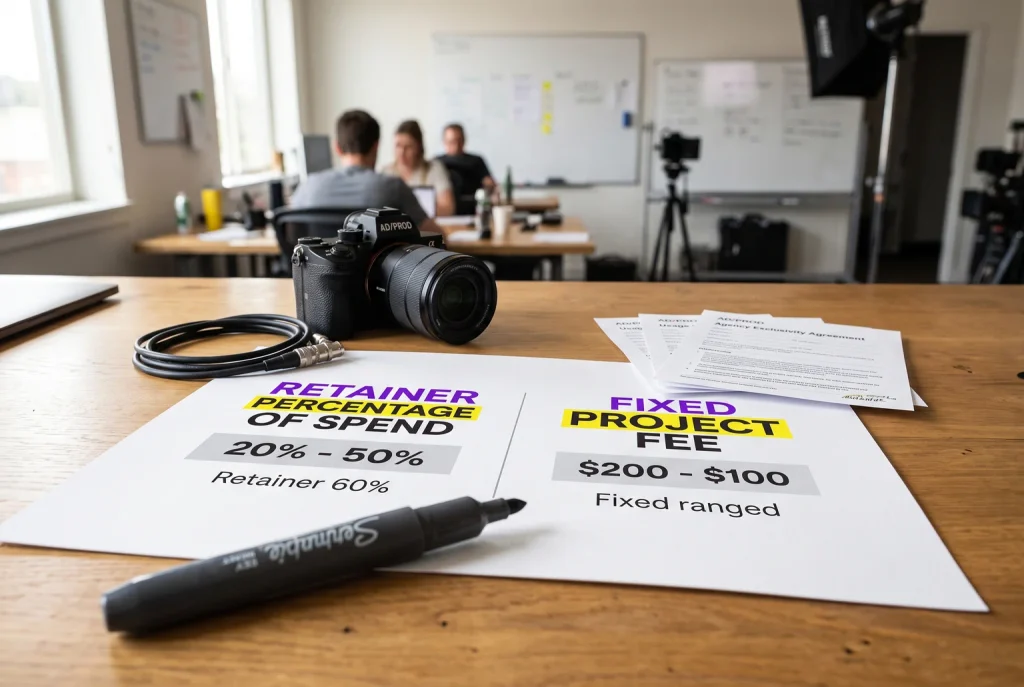
Influencer marketing agencies generally price their services in one of three ways, or some hybrid of the three.
A flat monthly retainer covers ongoing work such as strategy, creator sourcing, campaign management, and reporting. International benchmarks put this at roughly US$3,000 to US$25,000 per month, with the actual figure depending on how many creators are involved, which platforms are covered, and how much reporting and account management the client needs.
A percentage-based commission ties the agency’s fee to the size of the campaign, commonly 10% to 30% of total influencer fees or ad spend. Some agencies instead apply a 15% to 30% markup directly on top of what creators are paid, sometimes alongside a smaller retainer.
A fixed project fee covers a single campaign, like a product launch or seasonal push, with the total agreed upfront rather than billed monthly.
| Model | How it works | Typical use case |
|---|---|---|
| Monthly retainer | Flat fee, ongoing scope | Continuous influencer programs |
| Percentage of spend | 10-30% commission or markup on creator fees | Larger or ad-supported campaigns |
| Fixed project fee | One-off cost, agreed upfront | Single launches or seasonal activations |
Creator fees themselves sit outside these agency charges and vary by tier. On top of agency pricing, expect separate line items for production, paid media, usage rights, and exclusivity. None of this is standardized, so treat these as reference ranges rather than a rate card. Exact quotes require contacting an agency directly with campaign specifics.
Most agencies follow a similar sequence, even if the stage names differ from one provider to the next.
Timelines vary by scope, but a single campaign commonly takes several weeks from discovery to publication, longer if it involves multiple creators or extensive product seeding.
Arc Innovation and Insights, a Makati City digital marketing agency, is one example of a Philippine provider that packages the components described above into a named service line. Its influencer marketing page breaks the offering into four areas: influencer research, campaign strategy and planning, partnership management, and performance tracking.
The research component is described as identifying creators based on audience fit, content style, and brand-value alignment rather than follower count alone, which lines up with the vetting practices covered earlier in this guide. Campaign strategy and planning is framed around specific objectives such as brand awareness, engagement, lead generation, or sales, rather than a generic “get influencers” brief. Partnership management covers coordinating communication, deliverables, and timelines with creators from start to finish, and performance tracking involves monitoring reach and engagement and turning that into performance insights after the campaign runs.
Arc also offers a separate social media management service that includes creator discovery and vetting, content review, and posting coordination, suggesting influencer work is often bundled with ongoing social media handling rather than sold purely as a one-off project.
As with any agency, the scope, timeline, and cost of these services for a specific brand would need to be confirmed directly with Arc rather than assumed from the service page alone. Arc is useful here mainly as a concrete illustration of how the standard service list translates into an actual PH agency’s offering.
A few questions separate agencies that run real processes from those that just promise reach.
Ask for case studies that specify the objective, platform, budget range, and what exactly the agency was responsible for, not just a screenshot of high engagement. Vague reach numbers without campaign context are hard to verify.
Ask how creators are sourced and vetted. A real process checks audience demographics, engagement quality, brand safety, and past content, not just follower count.
Ask how success will be measured before the campaign starts. The agency should confirm which KPIs map to your actual business goal and be upfront about what conversion tracking can and can’t prove, since attribution across creator content is often limited.
Ask what reporting looks like day to day, not just at the end. A reasonable standard includes periodic updates during the campaign and a final report with raw platform data or screenshots, not summary slides alone.
Ask for an itemized quote that separates agency fees, creator payments, production, and paid amplification, and get contract terms on missed deadlines, revisions, and replacement creators.
For Arc Innovation specifically, ask to see a sample proposal, named account contacts, and how its stated research and tracking process would apply to your category.

A good influencer marketing agency in the Philippines should be able to explain its sourcing and vetting process, walk through pricing models in plain terms, and show what reporting actually looks like mid-campaign. Retainer, percentage-of-spend, and fixed project fee each fit different campaign sizes, but exact costs depend on scope, creator tier, and deliverables, so treat published ranges as a starting point, not a quote.
Arc Innovation and Insights is one PH agency built around this kind of structured process, covering research, strategy, partnership management, and tracking. Whether it or any other agency is the right fit depends on your budget and goals, which is a conversation best had directly with their team.
Input your search keywords and press Enter.