
November 13, 2026
If you are planning a new online store or rebuilding an old one, you need to answer three questions before anyone writes code or opens a design file: which platform to build on, which features the store needs at launch, and how much to budget. Getting any of them wrong usually shows up later as a migration, a rebuild, or a monthly bill nobody planned for.
The audience is large enough to justify the effort. The Philippines had 98 million internet users at the end of 2025, and that figure covers every age group and region, including people who browse on mid-range phones and shop through apps they already trust. Your store competes for that attention with marketplaces and social selling, so the build has to earn its place.
The Philippine context changes the answer to each decision. Platform choice depends on whether a system supports local payment methods such as GCash and Maya, and local couriers. Feature scoping has to account for cash on delivery, mobile-first browsing, and delivery across more than 7,000 islands. Budgets need to be set in pesos, with recurring costs such as hosting, payment fees, and maintenance counted next to the one-time build fee.

This guide covers the three decisions in order. It starts with the local shopper and market conditions that shape your requirements, then compares platforms and sets out a way to choose between them. After that it lists the features to plan for and gives PHP cost ranges, followed by advice on phasing spend and avoiding hidden costs.
Each condition below translates into something your store has to do on day one.
Mobile-first browsing. With 97.5 million internet users and 83.8% penetration at the start of 2025, your audience includes people on a wide range of phones and connections. Design product pages, filters, and checkout for a small screen first, and test on a mid-range Android device rather than only on a designer’s laptop.
E-wallets and cash on delivery. An e-wallet is a mobile app that holds money and pays online, such as GCash or Maya. Cash on delivery (COD) means the customer pays the courier when the parcel arrives. Your checkout should offer e-wallets alongside COD, with cards and bank transfers as extra options, as BSP payment data and trade guidance point to. COD carries a cost, though. It raises failed-order risk because the customer must be home and ready to pay. That calls for order confirmation by SMS or chat before dispatch, and the option to limit COD by order value or area.
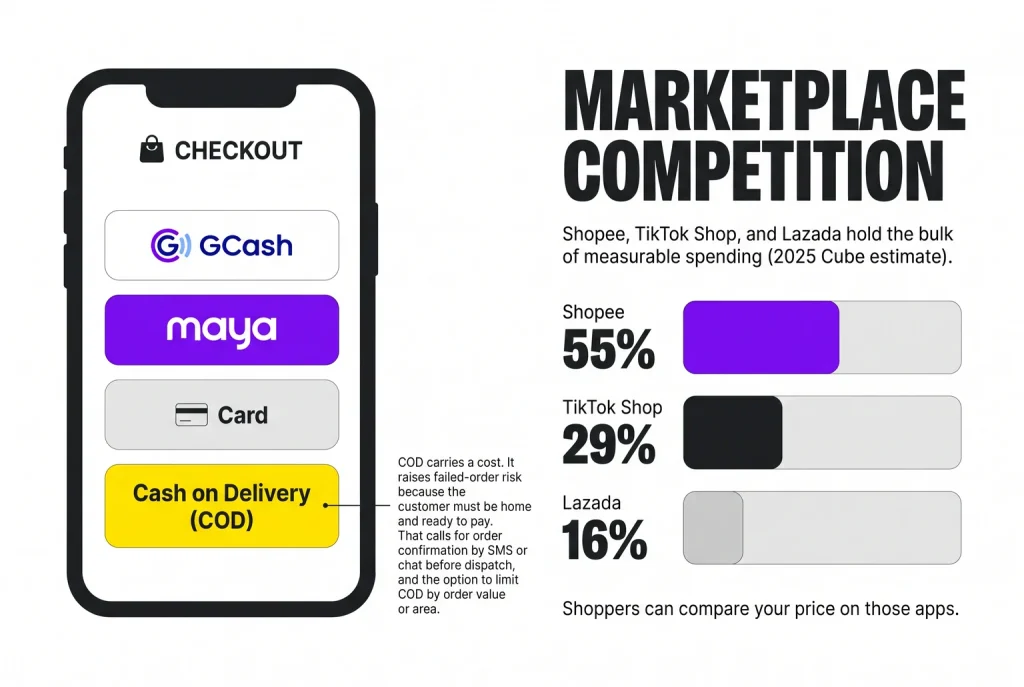
Marketplace competition. Shopee, TikTok Shop, and Lazada hold the bulk of measurable spending. A 2025 Cube estimate puts Shopee at 55%, TikTok Shop at 29%, and Lazada at 16% of their combined sales. Shoppers can compare your price on those apps in seconds, so your own site needs a reason to exist: a fuller catalogue, bundles, loyalty perks, or brand content. It also needs product data you can export and reuse across channels.
Logistics across islands. Shipping can take 20% to 30% of order value, and delivery runs from 24 to 48 hours in Metro Manila to 7 to 14 days in remote provinces. First-attempt delivery failures in dense Metro Manila zones reach 30% to 40% or higher, against a global average of 10% to 15%. Your site should calculate shipping by location, show realistic delivery windows before payment, connect to the couriers you use, and collect clear addresses with landmarks and a mobile number.
Six routes cover most Philippine stores. Three terms help with the table. SaaS (software as a service) means you rent a hosted platform for a monthly fee and the vendor runs the servers. Open source means the code is free to use and modify, but you arrange and pay for your own hosting and upkeep. Headless means the storefront customers see is built separately from the system that manages products and orders, which gives design freedom at a higher build cost.
| Platform | Best for | Strengths | Limitations | Cost model |
|---|---|---|---|---|
| Shopify | Small to mid-size brands that want to launch quickly | Hosted, large app store, documented Lalamove integration, PayMongo plugin | Prices in USD, extra fee on third-party gateways, Shopify Payments not listed for the Philippines | SaaS: US$19 to US$299 per month on annual billing, Plus from US$2,300 |
| WooCommerce on WordPress | Content-led brands and teams with a developer | Free open-source core, full control of code and data, PayMongo plugin | You manage hosting, security, updates, and extensions | Free software, plus hosting, theme, extension, and maintenance costs |
| Magento / Adobe Commerce | Large catalogues and complex B2B needs | Deep customisation, PayMongo plugin | Needs experienced developers and ongoing support | Quote-based licensing plus development and hosting |
| BigCommerce | Growing stores that want hosted plus built-in features | Hosted, published tiers | Fewer documented Philippine payment and courier connections | SaaS: US$29, US$79, US$299 per month billed annually, custom Enterprise |
| Custom or headless build | Unusual workflows or high-traffic brands | Total flexibility, you own everything | Highest build cost and a developer dependency | Project-based build fee plus maintenance |
| Marketplace only | Testing demand with no site | Built-in shoppers and traffic | Seller policies, fees, and customer data belong to the platform | Seller charges such as Shopee’s 2.24% transaction fee and ₱5 per order, waived for the first 50 successful monthly orders |
Fit comes down to who does the technical work. Shopify and BigCommerce shift hosting and security to the vendor, which suits teams without a developer. WooCommerce and Magento give you ownership of the code, and someone has to maintain it.
Check local payments and couriers on any platform before you commit. Because Shopify Payments is not listed as available in the Philippines, most Shopify merchants connect a local gateway. PayMongo documents plugins for Shopify, WooCommerce, and Magento, covering e-wallets and cards. A plugin existing does not mean your courier and COD workflow will run without configuration, so test GCash, COD, and courier rate calculation in a trial store.
A marketplace gives you the least ownership. Shopee, TikTok Shop, and Lazada control the customer relationship and the rules. Many businesses run a marketplace shop for reach and their own site for repeat buyers, which works as long as product data can be exported and reused.
A hosted plan costs more per month and takes less effort. WooCommerce costs less in licences and more in attention. Custom builds pay off only when a standard platform cannot do what the business needs.
Five questions narrow the field: how complex your catalogue is, who maintains the site, what systems it must connect to, where you expect to be in two years, and what you can spend each month. Three scenarios show how the answers play out.
A small seller launching with a few dozen products and no developer should start on Shopify. Hosting, security, and updates are handled for you, so time goes into photos, pricing, and testing GCash and COD. WooCommerce also works at this size, but it suits owners who already have WordPress skills or want heavy content customisation.
An SME moving an existing catalogue of several thousand products has two workable routes. Shopify allows a default maximum of 2,048 variants per product, so a single item with many size, colour, and material combinations may need splitting. WooCommerce has no built-in product ceiling, but speed depends on your hosting, caching, database tuning, and plugin choices. Its free licence does not remove those costs.
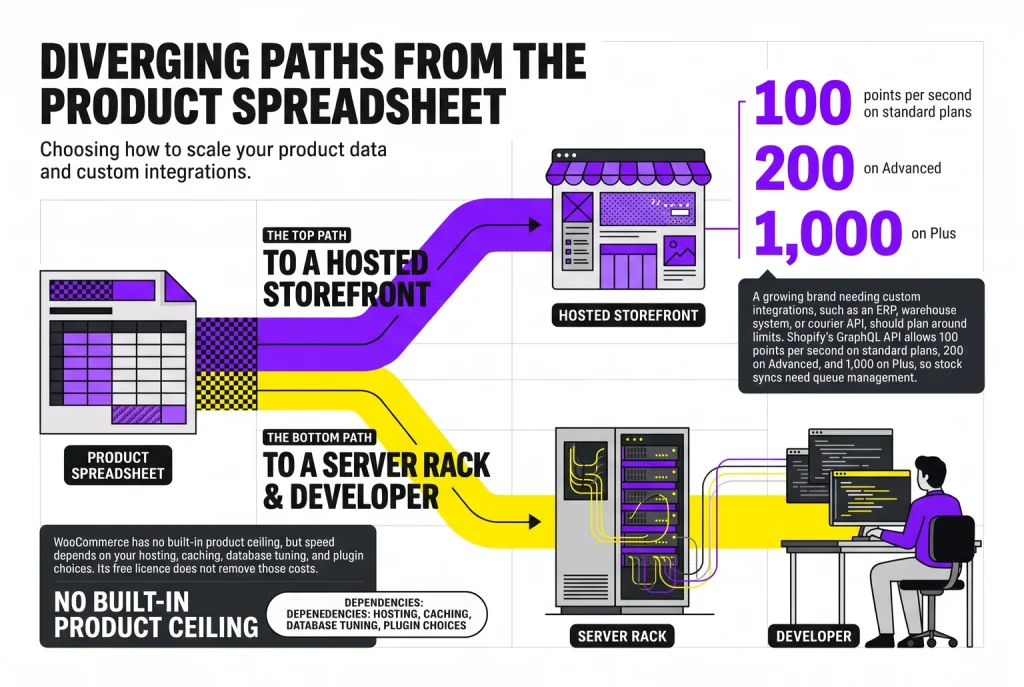
A growing brand needing custom integrations, such as an ERP, warehouse system, or courier API, should plan around limits. Shopify’s GraphQL API allows 100 points per second on standard plans, 200 on Advanced, and 1,000 on Plus, so stock syncs need queueing, retries, and bulk processing. Past that, Magento or a custom build is worth quoting, because complex catalogues and operations are better reasons to switch platforms than order volume alone.
| Your situation | Likely fit |
|---|---|
| Under 100 products, no developer | Shopify |
| Existing WordPress site or content-led brand | WooCommerce |
| Thousands of products, modest budget | WooCommerce with solid hosting, or Shopify with planned integrations |
| ERP, B2B pricing, or custom workflows | Shopify Plus, Magento, or custom |
| Testing demand before investing | Marketplace shop first |
If two rows fit, pick the platform your team can maintain without outside help, since that determines whether the store stays fast and secure after launch.
Baymard Institute’s tracking puts the global average cart-abandonment rate at 70.19%, so most feature decisions come down to removing reasons shoppers leave. Must-haves go in the first release. Growth-stage items can wait until orders justify them.
Storefront and UX – Mobile-first layouts, clear product pages, and search. A 0.1-second mobile speed improvement raised retail conversion rates by 8.4% in a Google and Deloitte Digital study, so compress images and limit heavy plugins.
Checkout and payments – GCash, Maya, cards, and cash on delivery, since these cover how local shoppers pay. Xendit, for example, documents GCash in PHP with redirect approval and a PHP 100,000 maximum per transaction. – Guest checkout, a short form, and shipping costs shown early. Extra costs drive 39% of abandonments, required accounts 19%, and long checkouts 18%. – A visible returns policy and trust cues near card fields. Returns affect 15% of shoppers and card-detail distrust 19%.
Fulfilment and inventory – Live stock counts and order status emails. – Courier rates or integrations. Slow delivery is a reason for 21% of abandonments. FedEx’s ecommerce web services support automated labels, transit-time estimates, and tracking, and DeliveryBox documents delivery-order and callback APIs.
Marketing and SEO – Search engine optimisation (SEO) means structuring pages so Google can rank them for what shoppers type. At launch you need unique titles, clean URLs, product descriptions, and a sitemap. – Analytics and ad pixels, so you can see which channels bring paying customers.
Security and compliance – HTTPS, regular updates, and backups. – Privacy notice, consent wording, and secure handling of customer data. Review Data Privacy Act of 2012 obligations with a lawyer or privacy adviser. – Confirm DTI business registration and BIR invoicing and tax requirements with your accountant.
The figures below are planning estimates drawn from published agency packages and vendor pages, not a market survey. Prices vary by provider and scope, and the build ranges were gathered in 2025 to 2026. Treat them as a starting point for quotes.
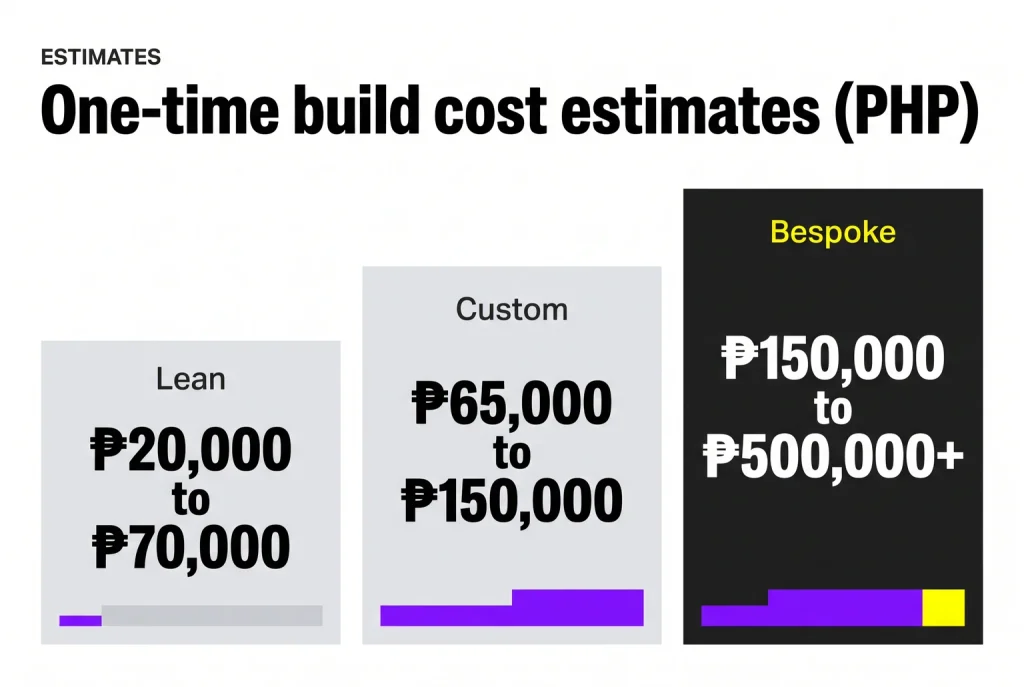
A template-based or lean store runs about ₱20,000 to ₱70,000, with one published package starting at ₱20,000. A customised WooCommerce or Shopify store sits around ₱65,000 to ₱150,000, and Starfish lists ecommerce projects at ₱65,000 to ₱120,000. Integration-heavy or bespoke builds run from ₱150,000 to ₱500,000 and above, depending on scope.
Domain, hosting, and SSL (the certificate behind HTTPS) are annual charges. The ranges below depend on the provider and plan.
| Cost component | Type | Low (PHP) | High (PHP) |
|---|---|---|---|
| Domain | Annual | 500 | 5,339 |
| Shared or basic hosting | Annual | 1,800 | 11,500+ |
| SSL certificate | Annual | 0 | 15,000 |
| Ecommerce hosting (managed, larger stores) | Annual | 15,000 | 50,000 |
| Maintenance | Monthly | 10,000 | 50,000 |
The ecommerce hosting and maintenance figures come from Truelogic. Basic hosting suits a small catalogue, while the higher hosting row applies to busier stores. Many providers bundle SSL at no charge, which explains the ₱0 low end.
Shopify folds hosting into its subscription. The Basic plan costs US$25 a month, or US$19 a month billed yearly. Apps and plugins can add recurring costs on any platform. Check each vendor’s current pricing before including an extension in your budget.
Gateways charge per transaction rather than a flat fee. PayMongo’s standard rates are 3.125% + ₱13.39 for cards and 2.23% for GCash, listed as VAT-exclusive with no setup fee. Maya Business Checkout starts at 3.50% + ₱10 for Visa and Mastercard, 1.0% for QR Ph, and 2.0% for GCash. On a ₱1,000 GCash order through PayMongo, the fee is about ₱22.30.
Design, content and photography, integrations, and marketing are priced by scope, so published ranges for them are thin. Design and development are usually bundled into the build tiers above. Product photography depends on catalogue size, integrations depend on how many courier, ERP, or marketplace connections you need, and marketing spend depends on your sales targets. Get itemised quotes for these rather than relying on a single average.
Budget the build and the upkeep as two separate lines. A common rule of thumb sets aside 15 to 20 percent of the original build cost each year for maintenance and improvements. Elogic Commerce puts basic maintenance at 10 to 15 percent, managed monitoring and support at 15 to 25 percent, and business-critical operations up to 40 percent. On a ₱150,000 build, 15 percent is ₱22,500 a year.
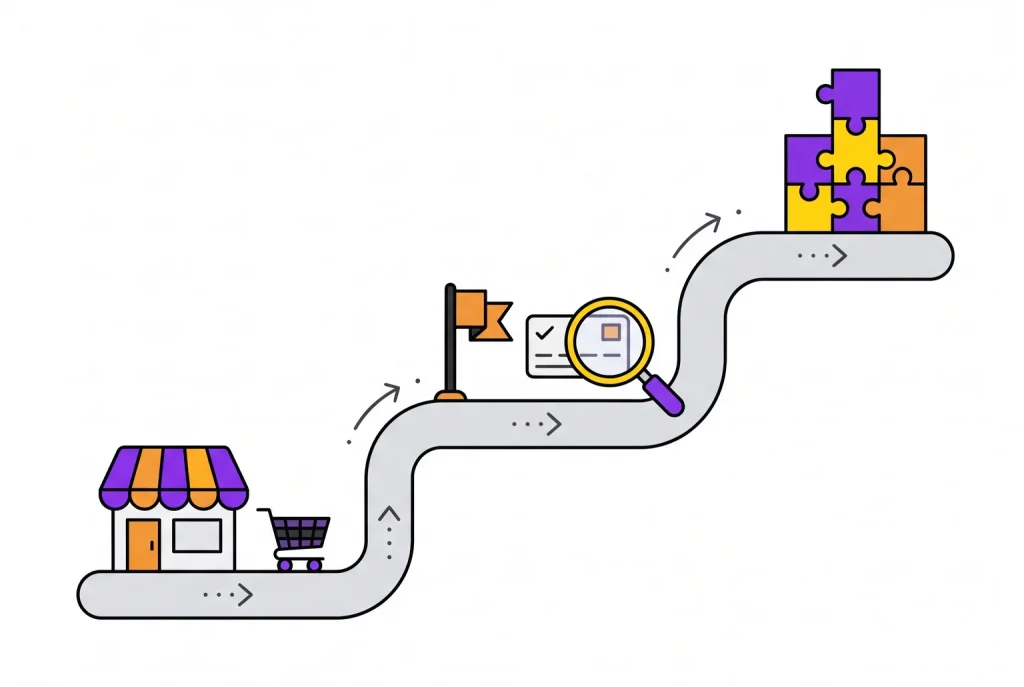
Phase the build around the purchase journey. Launch the smallest store that can complete and measure a real purchase: browsing, cart, checkout, payment, order confirmation, customer contact, and basic security. Set targets for conversion rate, customer-acquisition cost, and average order value first. A soft launch of 2 to 4 weeks, one roadmap’s suggestion, exposes checkout and fulfilment problems before you promote widely. Add retention tools and deeper integrations later, based on what customers actually do.
Active noindex tags, irrelevant redirects, and lost metadata can undermine indexing and organic traffic. Map redirects URL by URL, keep SEO metadata and structured data, remove crawl restrictions left on the staging site, and test customer and order data in staging before switching over.
A store that sells is the sum of the decisions in this guide: a platform that fits your catalogue and payment mix, a feature set sized to your stage, and a budget that covers both the build and the upkeep. At Arc Innovation and Insights, we provide website design and development in the Philippines, aimed at building trust, attracting qualified visitors, and turning them into leads, inquiries, bookings, and online sales.
We approach projects from an entrepreneurial standpoint, with return on investment in view, and aim to work as a long-term business partner rather than a one-off vendor. Ecommerce scope, platform choice, and timelines are best settled in a direct conversation about your products and goals.
To plan your online store, contact us for website design and development.
Input your search keywords and press Enter.