
November 13, 2026
You have a fixed amount to spend on getting found online, and two options that both claim to bring in customers. Google Ads charges you each time someone clicks. SEO takes months before it pays off. Most comparisons tell you both work, which does not help when you can only fund one this quarter.
The case for putting money into Google at all is strong. DataReportal counted 97.5 million internet users in the Philippines in January 2025, 83.8% of the population, and Filipino users spend an average of 8 hours and 52 minutes online per day. Shoppers also check online before buying in person. Google and Kantar TNS research from 2017 found Filipino buyers run six to seven online searches and consider two to three brands before they commit, and 36% of baby-care buyers still looked for a brand in-store after searching online.
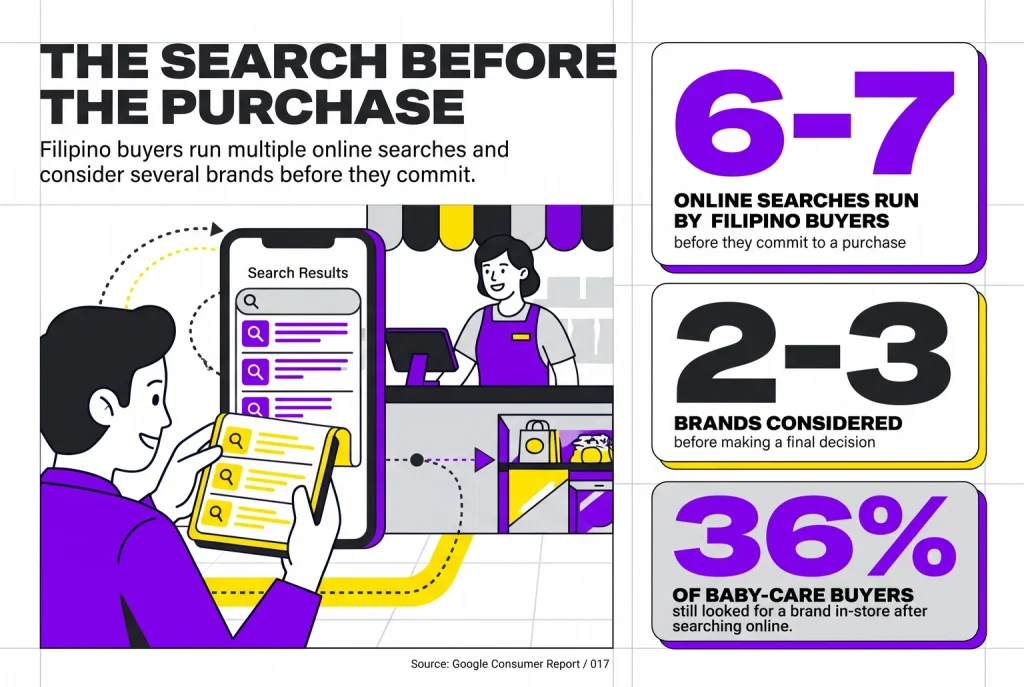
Your customers are already searching. What differs is how quickly each channel puts you in front of them, what it costs in pesos, and how long the result lasts once you stop paying.
This post gives you a way to decide. The right first move depends on three things: your business type (local service, e-commerce or B2B), your cash flow, and whether you need leads this month or steady growth over the year. By the end, you will have a verdict for each case, plus guidance on when to run both and in what order.
When someone in Manila types “dental clinic near me” into Google, the page that comes back has two kinds of listings. Knowing which is which makes the rest of this post easier to follow.
Paid listings are Google Ads. Businesses pay to be placed above or below the unpaid results, and Google marks each one with an “Ad” or “Ads” label. Google runs an auction to decide which ads appear and in what order.
Unpaid listings are the organic results. SEO, short for search engine optimisation, is the work of earning a spot there: making your website useful and clear enough that Google chooses to show it. You do not pay Google for that spot, though you do pay for the work (writing, fixing your site, building your reputation).
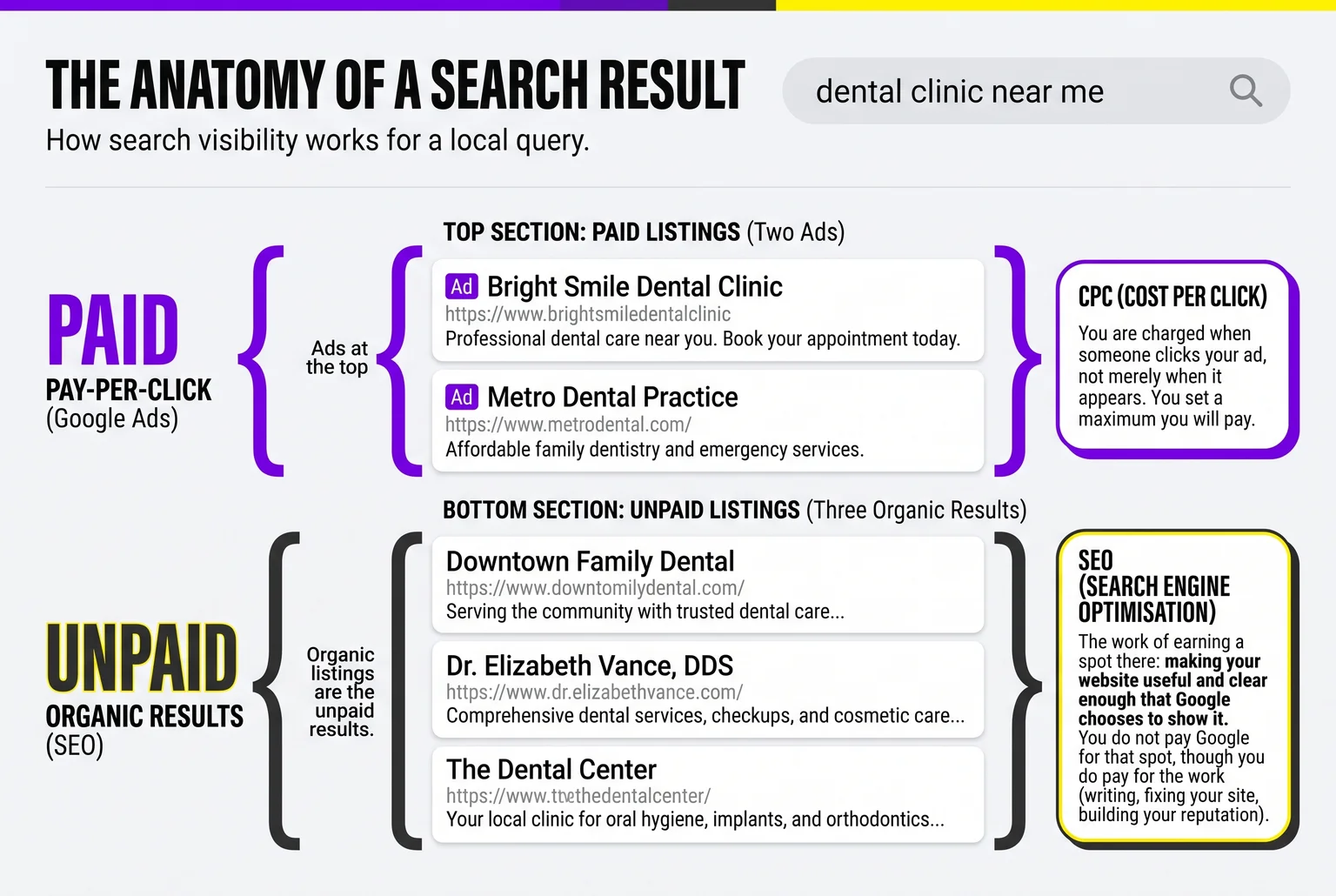
Three more terms come up throughout the post.
CPC stands for cost per click. With Google Ads you are charged when someone clicks your ad, not merely when it appears. You set a maximum you will pay, and the actual price per click can be lower. It is not a fixed rate either. It varies with competition, location, what was searched and the quality of your ad, so a popular search in Metro Manila costs more per click than a quiet one elsewhere.
A conversion is the action you actually want a visitor to take. Examples include a purchase or sign-up on your website, an app download, and some offline outcomes such as a phone call. Conversion tracking measures what happens after someone interacts with your ad, which tells you whether the clicks you paid for produced customers.
SEM, search engine marketing, is the umbrella term for getting visible in search. Some people use it to mean paid ads only, others to cover both ads and SEO, so check which meaning a vendor intends.
One analogy helps with the cost difference. Ads are like renting a stall in a busy mall: you are visible while you pay and gone when you stop. SEO is closer to building your own shopfront, which costs more upfront and takes longer, but stays yours.
Local searches are where a small Philippine business has the best odds of being found without paying for every click. A Philippine local-search practitioner reports that about 46% of Google searches have local intent, that “near me” searches rose 150%, and that “open now” queries nearly doubled. The practitioner does not identify the underlying Google dataset, so read these as directional, not exact. The implication is still clear for a clinic, salon, repair shop or restaurant: people searching this way are close to buying, and a complete Google Business Profile (your free listing on Google Maps and search) can put you in front of them. That means an accurate address, hours, phone number, reviews and directions. This work is a form of local SEO, and it costs time more than money.

The market is also growing. The Philippines’ digital economy reached an estimated $31 billion in gross merchandise value in 2024, up from $26 billion in 2023, roughly 20% growth, according to the Google, Temasek and Bain e-Conomy SEA 2024 report. Gross merchandise value is the total value of goods sold online. For an e-commerce seller, a growing market means more buyers searching but also more sellers bidding for the same clicks.
Google Ads has no fixed nationwide cost per click in the Philippines. Published estimates are agency or modelled benchmarks, not full auction data, and they disagree. For property, one Philippine guide puts competitive-market clicks at ₱60 to ₱250, while another gives a typical range of ₱25 to ₱70. Costs shift by keyword, location and ad quality.
Taken together, local-intent businesses should build their free listing and website basics first, since those carry the most searches at the lowest cost. Ads suit a narrow, high-value keyword where you need leads sooner than organic results can deliver, and where you can afford the clicks.
Google Ads charges you for each click, so your cost is ad spend plus whatever you pay someone to run the account. SEO has no per-click charge. You pay for the work of improving your website and Google listing, whether you do it yourself or hire help. Keep those two costs separate when you plan, because ad spend goes to Google and fees go to the person doing the work.
| SEO | Google Ads | |
|---|---|---|
| Upfront cost | Website fixes and content; can be your own time | Account setup and conversion tracking; no minimum beyond your daily budget |
| Monthly cost in PHP | Fees only. One Philippine provider’s illustrative ranges are ₱5,000 to ₱15,000 for freelancer-level work and ₱15,000 to ₱50,000 for boutique-agency packages | Ad spend plus any management fee. Estimate spend as leads wanted, divided by your conversion rate, times your cost per click |
| Time to first results | Weeks to months | Days, once ads are approved |
| Time to stable results | Usually many months | Within a few weeks, as you remove poor keywords |
| If you stop paying | Rankings usually stay for a while, then may slip | Clicks stop that day |
| Main risk | Slow payoff, with no guarantee of ranking | Spend rises faster than sales |
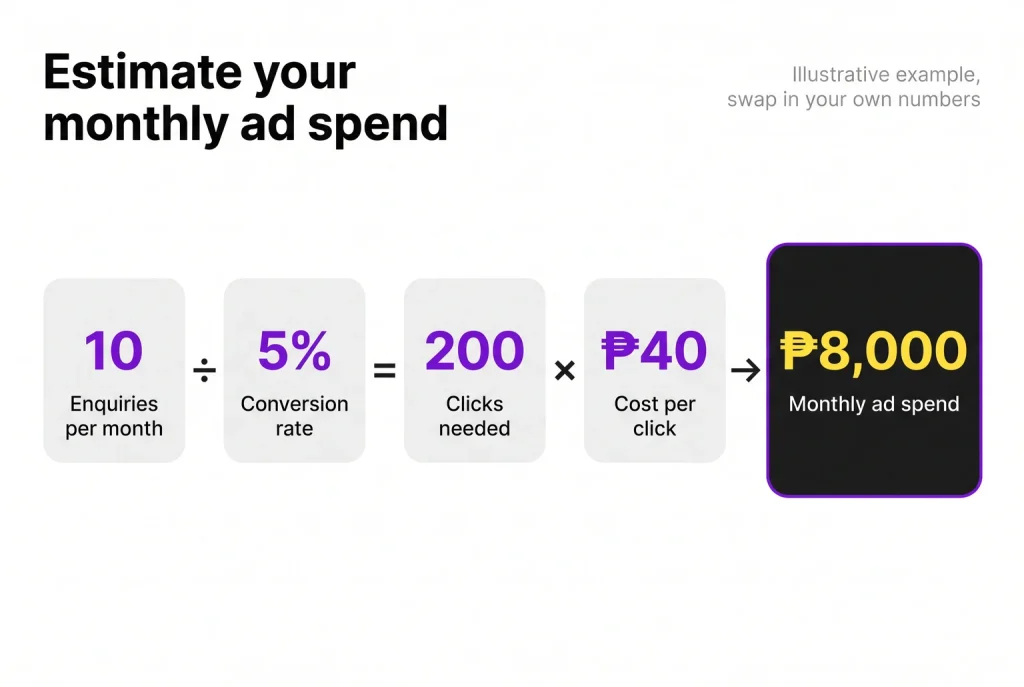
The figures are a provider’s published ranges, not a market survey, so treat them as a starting point for quotes. Estimate your ad spend from your own targets using the formula below. Say you want 10 enquiries a month, your website turns 5% of visitors into enquiries, and a click costs ₱40. That is 200 clicks, or ₱8,000 in ad spend. Swap in your own numbers.
For reference, US advertisers averaged $5.26 per click and a 7.52% conversion rate in 2025, up from $4.66 and 6.96% in 2024. Those come from US campaigns, so they show the direction of costs and not what you will pay in Manila or Cebu.
On speed, SEO is slower than most owners expect. In an Ahrefs study of newly published pages, only 1.74% reached Google’s top 10 within a year. Among pages that did eventually get there, 40.82% did so within the first month. That second figure covers only the winners, so it does not mean four in ten new pages rank quickly. Local listings in a less crowded niche can move faster than broad topics, but plan for months.
Ads have the opposite weakness. They deliver quickly and leave nothing behind. The day your budget ends, you have no ranking, no traffic and no leads from that channel. SEO work, such as a fixed website and a complete Google listing, keeps earning after you stop paying for it, though it is not permanent.
The numbers below are invented to show the shape of each channel. Your results will differ by industry, location and competition, and neither channel comes with a guaranteed return.
Take a dental clinic in a mid-sized Philippine city. Dental advertisers averaged an 8.36% conversion rate in 2024, but that is a US benchmark, so assume a more cautious 5% for a basic clinic website. Assume a click costs ₱40 and the clinic wants 10 enquiries a month.
The arithmetic: 10 enquiries ÷ 5% = 200 clicks. 200 clicks × ₱40 = ₱8,000 a month in ad spend. Over 12 months that is ₱96,000, plus any management fee.
For SEO, assume a freelancer at ₱10,000 a month, within the range quoted earlier. That is ₱120,000 over 12 months. Assume the site produces 1 enquiry a month in months 1 to 3, 3 in months 4 to 6, 6 in months 7 to 9, and 10 in months 10 to 12. These figures are assumptions, not forecasts. Google itself says search improvements can take several months and are not guaranteed.
| Month range | Ads: enquiries per month | SEO: enquiries per month |
|---|---|---|
| 1 to 3 | 10 | 1 |
| 4 to 6 | 10 | 3 |
| 7 to 9 | 10 | 6 |
| 10 to 12 | 10 | 10 |
| 12-month total enquiries | 120 | 60 |
| 12-month cash outlay | ₱96,000 | ₱120,000 |
In this example Ads cost about ₱800 per enquiry and SEO about ₱2,000 over the first year. SEO loses the first year on cost. The difference shows in month 13. If the clinic stops paying, Ads drop to zero enquiries that month. The SEO pages may keep producing something close to month 12’s level for a while, though rankings can slip.
A careful owner would also test the assumptions. If SEO stalls at 3 enquiries a month, it never catches up. If your conversion rate is 2.5% instead of 5%, the ad bill doubles to ₱16,000 a month for the same 10 enquiries.
Reported conversion rates for organic and paid traffic vary widely by source and sector, so do not assume either channel converts visitors better. One dataset of over 5 million conversions put organic at 4.9% and paid at 5.4%. Use your own tracking once you have data.

Answer three questions first. How many months of marketing spend can you cover before sales improve? How long does a customer take to decide, from first search to payment? Do you want orders this month, or a steady flow of enquiries a year from now? Short runway, short decision time and a need for orders now point to Google Ads. Longer runway, longer decisions and a steady-flow goal point to SEO.
| Business type | Choose first | If cash flow is tight | What changes the answer |
|---|---|---|---|
| Local service (clinic, salon, repair, tutor) | Google Business Profile, then Google Ads | Skip paid ads until the profile is complete and collecting reviews | Many competitors already bidding in your city, or a high-value service, favours adding SEO sooner |
| E-commerce store | Marketplace listings on Shopee, then Google Ads for your own site | Stay on marketplaces only | Strong repeat customers or a distinctive product justify building your own site’s search traffic |
| B2B company | SEO and useful research content | Publish a few pages answering buyer questions before paying for clicks | A defined offer and landing page, plus a budget for ongoing tuning, justify adding Ads |
Start with your Google Business Profile, the free listing that shows your hours, phone number, photos and reviews on Google Search and Maps. Google says local results are mainly based on relevance, distance and prominence. Complete, accurate details help Google judge relevance, and prominence reflects how well known you are. You cannot change distance, but you can fill in every field, choose the right categories and ask satisfied customers for reviews. This costs time rather than pesos, so it suits a tight budget. Add Google Ads when you need bookings within weeks, as in the clinic example above.
For standardised products where shoppers compare prices, and where cash is limited or the website is weak, marketplace visibility is the usual starting point. Cube estimates Shopee, Lazada and TikTok Shop generated about US$22 billion in Philippine sales in 2025, with Shopee holding roughly 55% of that total. Once marketplace sales show that people want your product, add Google search and Shopping ads to build a channel you own, which reduces dependence on marketplace fees and algorithms.
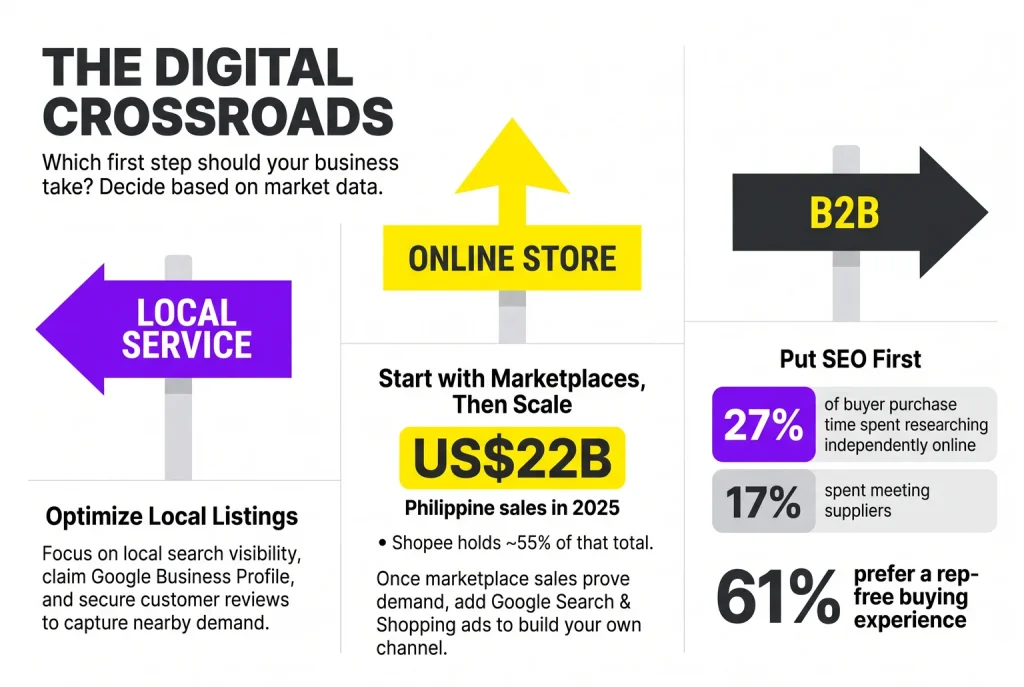
Put SEO first. A Gartner survey found buyers spend 27% of their purchase time researching independently online and only 17% meeting suppliers, and 61% prefer a rep-free buying experience. Forrester also lists long purchase cycles as a complication. Content that answers buyer questions keeps working through that long wait. Add Ads once you have a clear offer, a landing page and money for ongoing optimisation.
The order that suits most small budgets is Ads first for testing, SEO alongside, then a gradual shift as organic leads appear. The splits below are illustrative. Nothing in the research sets a universal ratio, so treat them as a starting point to adjust against your own results.
Months 0 to 3. On a lean budget, put roughly 70% into Ads and 30% into basics: a fast page and a few pages built around your best-selling service or product. Ads show quickly which searches bring enquiries. Google’s search terms report lists the actual phrases people typed before clicking. Qualified phrases become keywords and page topics, and irrelevant ones can be blocked with negative keywords.
Months 3 to 6. Move toward 50/50. Google Search Console, a free tool showing which searches already bring people to your site, can be filtered by page, device and date. Queries with many views but few clicks point to titles worth rewriting.
Months 6 to 12. Shift toward 30% Ads and 70% SEO if organic enquiries are rising. Trim Ads on queries where you already rank well, then check whether total enquiries hold. Do not cut blindly. Google’s 2012 analysis of 390 pause studies estimated that 50% of ad clicks were incremental when the advertiser ranked first organically, meaning half would not have arrived otherwise.
Trigger points for moving money: conversion tracking is recording enquiries, organic enquiries are steady for two to three months, and total leads stay level after a small ad reduction.
| Your situation | Start with | Then |
|---|---|---|
| Customers need you now, and cash is steady | Google Ads | Add SEO once leads cover costs |
| Cash is tight, sales cycle is long, no urgency | SEO | Add small test ads |
| Local service, e-commerce or B2B with some room | Both in sequence | Ads first, shift budget as rankings grow |
Your checklist for the next seven days:
At Arc Innovation and Insights, we approach marketing from an entrepreneurial standpoint: your budget is an investment that should support measurable business goals. If you need a long-term partner to plan or run SEO, Google Ads, or both in sequence, get in touch with us to discuss your budget and goals.
Input your search keywords and press Enter.