
If you have asked three providers for a website quote and gotten three wildly different numbers, you are not alone. One “basic website” quote might cover five pages and a contact form. Another labeled the same way might include custom design, a content management system, and SEO setup. Comparing them side by side without understanding what is actually included is close to impossible, and that gap is a common source of budget surprises for Philippine SMEs.
This guide walks through what website projects typically cost in the Philippines, broken down by provider type, and what specific factors push a quote higher or lower. It covers what a normal project timeline looks like from first meeting to launch, and what to check for before signing with a provider, so a “final price” does not turn into a stream of add-on fees.
None of the figures here are guaranteed quotes. Prices vary by provider, scope, and negotiation. The goal is to give you enough grounding to read a proposal critically, ask the right questions, and brief a project clearly enough that the quote you get back actually means something.

Prices below are general market benchmarks pulled from multiple pricing guides and provider pages, not fixed rates you should expect to be quoted exactly. Treat them as a way to sanity-check a proposal, not a price list.
Freelancers. Junior freelancers commonly charge somewhere in the ₱8,000 to ₱25,000 range for a basic site, while more experienced freelancers ask for ₱25,000 to ₱60,000, according to a 2026 pricing overview. Several sources converge on ₱15,000 to ₱60,000 for a standard small-business build, with fully customized freelance work sometimes reaching ₱80,000. These figures usually cover design and build only. Domain registration, hosting, premium plugins, and ongoing maintenance are typically billed separately.
Small agencies. Small Philippine agencies tend to charge ₱20,000 to ₱50,000 for a basic business site and ₱50,000 to ₱200,000 for something more custom, like a corporate site with specific branding and content needs, per one pricing breakdown. Published agency packages vary widely in what they bundle. Some list flat packages around ₱35,000 to ₱78,000; others quote entry tiers starting near ₱8,880 to ₱12,000 that assume a template-based build with limited customization.
Ecommerce and custom builds. This is where ranges widen the most. Platform-based online stores (built on existing ecommerce platforms rather than from scratch) generally run ₱70,000 to ₱300,000. A bespoke ecommerce build, with custom development, hosting, and payment gateway integration, is often estimated at ₱320,000 to ₱550,000 for the first year alone. Broader industry estimates put ecommerce development anywhere from ₱150,000 to ₱800,000 or more, and complex custom web applications can climb past ₱1,500,000, per Studio Aurora’s pricing guide.
The overlap between tiers is real. A skilled freelancer’s top rate can exceed a small agency’s entry package, which is exactly why the next section matters: what you’re actually paying for.
Before comparing quotes, it helps to know what a few terms mean. A CMS, or content management system, is the software (like WordPress or Shopify) that lets you edit pages, add photos, or publish blog posts without touching code. SEO, or search engine optimization, is the work of making a site show up in Google results, through keyword research, page structure, and technical fixes. Ecommerce simply means the site can sell products online, with a shopping cart, checkout, and payment processing built in.
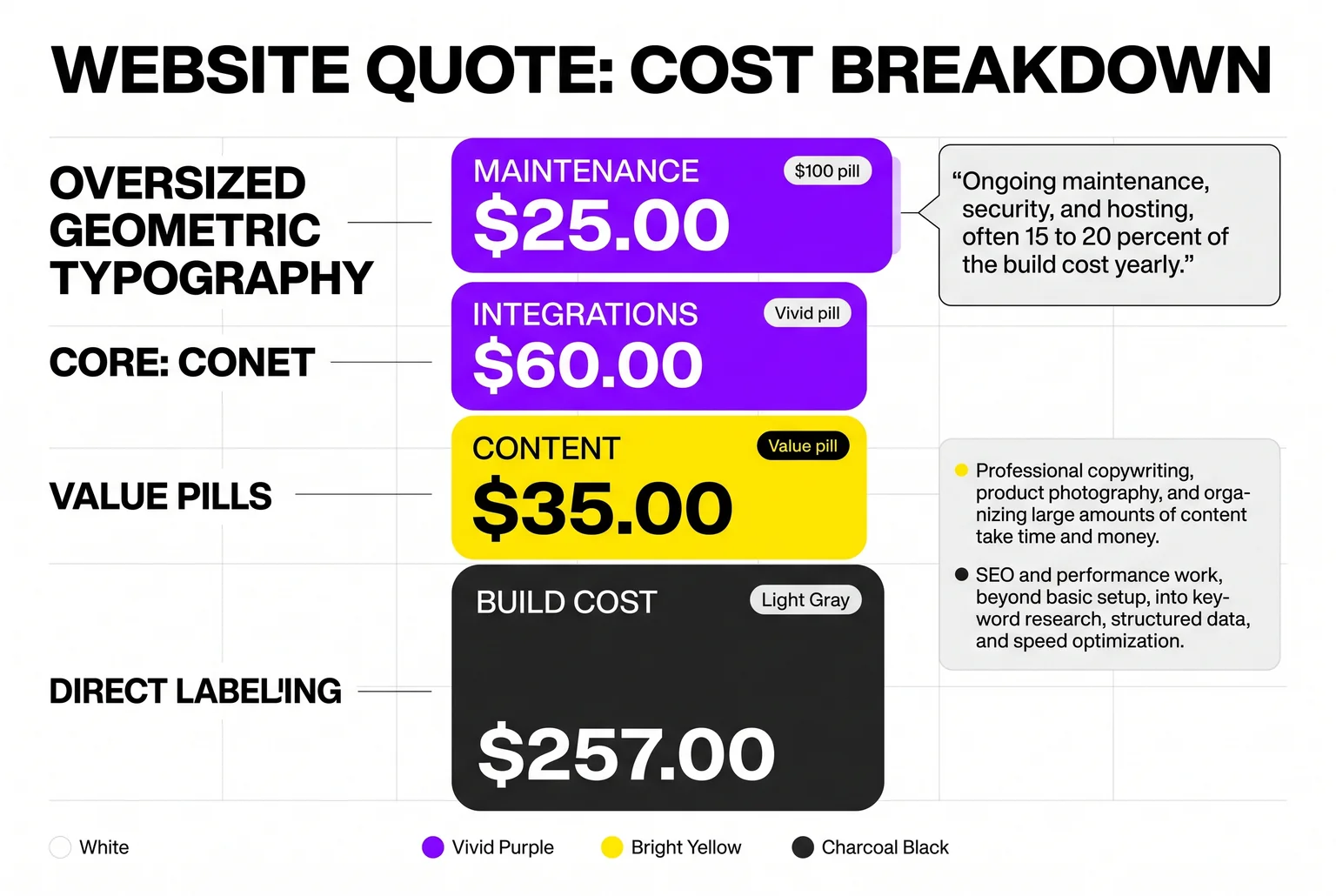
With that in mind, the biggest cost drivers are:
A website project generally moves through six stages. Knowing them helps you spot delays early and know what’s reasonable to ask for at each point.
Discovery
This is where the provider asks about your business goals, target audience, must-have features, budget, and timeline. A simple small-business site can move through this in about a week; a more complex project may take up to four.
Information architecture and content planning
The team maps out your sitemap, navigation, and how content will be organized page by page, often producing wireframes (rough page skeletons) before any visual design starts. This stage usually runs one to two weeks.
UX and visual design
Wireframes turn into actual layouts, with your branding, colors, typography, and imagery applied. You should be reviewing and approving designs here, before development starts, since changes are cheaper to make on a design file than on a built page. This typically takes two to four weeks combined.
Development
Developers build out the actual site, connect the CMS, set up forms, and wire in any integrations. For a standard 5 to 15 page small-business site, this whole build can run 4 to 8 weeks in total, assuming you’re providing feedback and content on time. More complex agency projects can run 3 to 8 weeks for this phase alone.
Testing and review
Before launch, the site should be checked across browsers and devices, with forms, links, page speed, and security settings all verified. This typically takes one to two weeks.
Launch and post-launch support
The site goes live, with DNS, hosting, and analytics tools switched on and monitored for issues in the first days after launch. Many providers offer ongoing support after this, covering updates, backups, and bug fixes.
Altogether, a mid-complexity project often runs 10 to 24 weeks, per typical agency estimates. Slow content delivery or delayed approvals are the most common reasons projects run long.
Picking a provider on price alone is the most common way projects go sideways. A better approach is to check relevant portfolio work, ask for references, and compare how each provider handles process, deliverables, and total cost, not just the headline number on a quote.
Before signing anything, confirm the following:
Before final payment, log into every account yourself and confirm you can update, back up, and migrate the site without the provider’s help.

Arc Innovation and Insights, a Makati-based agency, is one example of a Philippine provider bundling website design and development with related services. Its web development scope covers front-end and back-end build, CMS setup, third-party integrations such as payment gateways, CRMs, and booking engines, plus e-commerce features like product catalogs, checkout pages, and shipping settings. The same page lists performance work (image compression, caching, database optimization) and security tasks (SSL setup, backups, role-based access) as part of the build.
This kind of bundled scope, design, development, e-commerce, and ongoing technical upkeep under one provider, is common among small-to-mid agencies in the market. It is one useful reference point when comparing what a quote should typically include, not a benchmark for pricing.
A realistic budget, a clear sense of process, and a short list of questions for potential providers put you in a stronger position than most first-time buyers. Expect quotes to vary based on design complexity, integrations, and content needs, not just provider size. Walk into conversations with providers, whether a solo freelancer, a small agency, or a larger studio, ready to explain what pages you need, what the site should do, and what ownership and support terms matter to you. That clarity is what turns a vague quote request into a project you can actually compare and approve with confidence.
Input your search keywords and press Enter.