
November 13, 2026
Nearly 91 million Filipinos were active social media users as of January 2025, 78% of the population, up from 73.4% just a year earlier. Filipinos aged 16 and up spend an average of 3 hours and 32 minutes a day on social platforms, across roughly 8.36 apps a month, and still 11% of Filipino small businesses reported not using social media at all to reach customers.
That gap between audience size and business adoption is where most buyers get stuck: too many platforms to manage well, too many providers offering vaguely similar packages at wildly different prices.
This guide breaks down the services agencies typically bundle together, what those services actually cost in the Philippine market by tier, and how to read a proposal, a contract, and a red flag before you sign anything.

Packages differ by provider, so it helps to know the five functions that most bundles draw from before comparing quotes side by side.
Some providers also offer add-ons like influencer partnerships or dedicated video production, usually priced separately.

Published Philippine pricing varies widely because “management” means different things to different providers. Solo freelancers and virtual assistants tend to sit at the bottom of the range, with beginner-level rates around ₱3,000 to ₱5,000 monthly and experienced freelancers charging ₱10,000 to ₱20,000 or more, according to a 2026 freelance pricing guide. Boutique agencies generally land in the ₱18,000 to ₱35,000 range, while full-service agencies handling multiple platforms, paid ads, and content production can run ₱22,000 to ₱65,000 or higher per month, based on one 2025 agency-cost breakdown. Multi-channel retainers at full-service firms sometimes reach ₱100,000 to ₱300,000, though that tier usually includes dedicated creative and paid-media teams, not just posting.
If you’re outsourcing individual tasks rather than a full retainer, per-project fees of US$50 to US$150 per content bundle or hourly rates of US$8 to US$12 for specialists are common alternative pricing models, per 365Outsource’s cost breakdown.
| Tier | Typical monthly range | Usually includes |
|---|---|---|
| Freelancer / solo | ₱5,000 to ₱20,000 | Basic content and scheduling, limited platforms |
| Boutique agency | ₱18,000 to ₱50,000 | Content, community management, some reporting |
| Full-service agency | ₱22,000 to ₱150,000+ | Multi-platform strategy, paid ads, production, analytics |

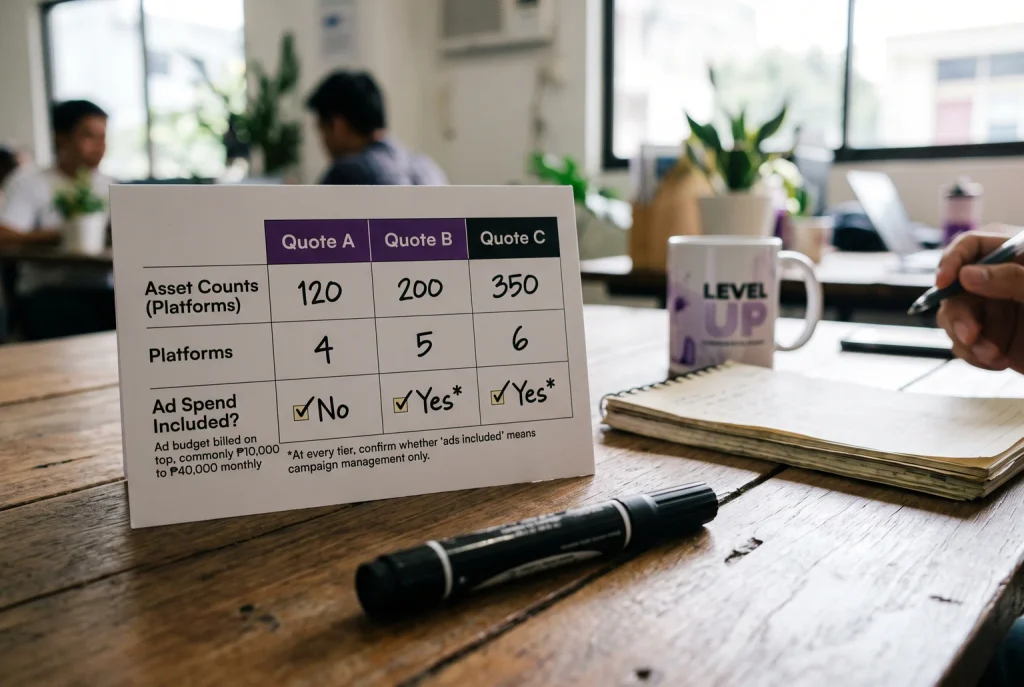
These are benchmarks, not fixed tariffs. Two quotes at the same price point can cover very different scopes, so always ask what’s included before comparing numbers side by side.
At the entry level, roughly ₱8,000 to ₱18,000 monthly, expect one platform, about 8 to 12 posts, and one or two basic Reels, with captions, scheduling, and simple graphics but usually no ad spend and limited community management. Some entry packages, like those from PH Premium Digital Marketing, list around 10 to 13 graphic posts plus basic ad setup at this range, though setup isn’t the same as running paid campaigns.
Mid-tier packages, roughly ₱20,000 to ₱45,000, typically add a second platform, push to 4 to 6 posts per week, include short-form video, and start covering routine comment and message replies. This is where a 2026 pricing guide places “standard management.”
Full-service tiers, ₱60,000 and up, usually mean daily content, three or more platforms, 20 to 30-plus monthly assets, heavier video production, and paid social campaign management layered on top. ScaleUP Agency’s premium package, for instance, adds paid-ad management and a studio shoot on top of its base content deliverables.
At every tier, confirm whether “ads included” means campaign management only. Ad budget is almost always billed on top, commonly ₱10,000 to ₱40,000 monthly depending on the campaign goal.
A proper start with a new agency involves a signed scope document, access setup, and an audit before any posting begins. Expect the agency to request role-based access to your social accounts, ad accounts, and analytics tools rather than your personal passwords, and to run a kickoff call covering goals, target audience, brand voice, approval workflow, and who signs off on content before it goes live. A review of existing posts, past performance, and competitors typically follows, giving both sides a baseline to measure against later.
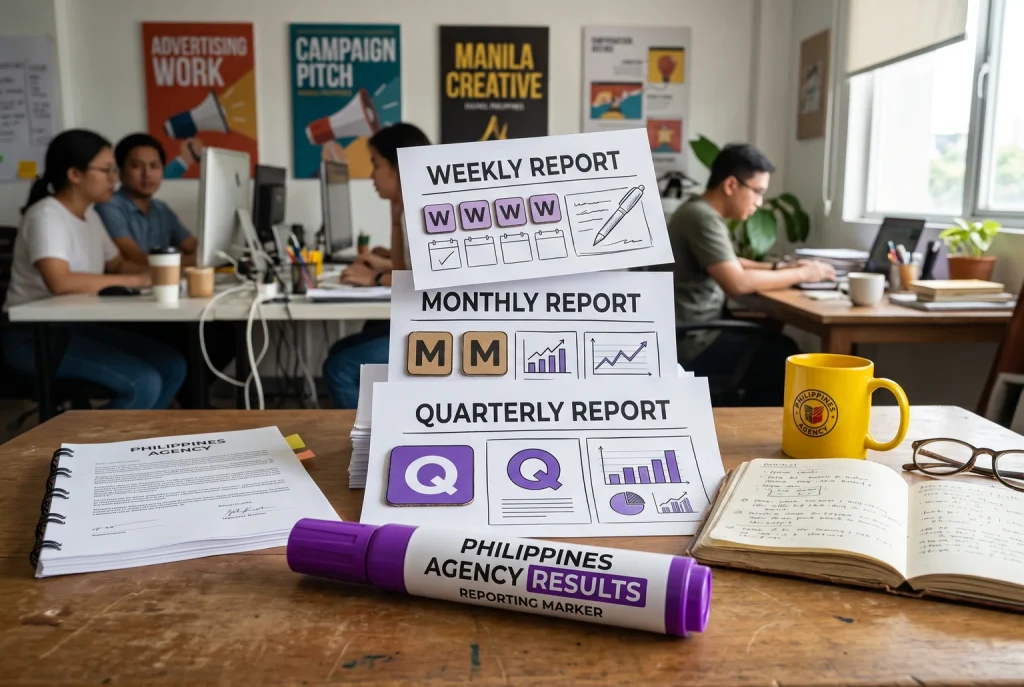
Reporting cadence should be spelled out in the contract, not left informal. Monthly reporting is the norm for most retainers, tying results back to business goals rather than just listing metrics, per a survey cited by SocialPilot putting monthly reporters at 46%, versus 18% quarterly and 14% weekly. Weekly updates tend to be short and tactical, useful mainly for active campaigns or high ad spend, while quarterly check-ins suit longer-term strategy conversations.
On commitment length, a three-to-six-month minimum is a reasonable benchmark for digital marketing work generally, since SEO.com.ph notes SEO alone needs at least six months to show results. There’s no fixed legal standard for these contracts in the Philippines, so minimum terms, notice periods, and exit clauses vary by agency and are worth reading closely before signing.
A few patterns show up repeatedly in complaints about agency work, and most are easy to spot before you sign anything.
[Image failed: side by side comparison of two sample reports one showing only likes and followers the other showing conversions and cost per]
It’s also worth checking a prospective agency’s name alongside terms like “scam” or “complaint” before signing anything, since platforms don’t always vet advertisers thoroughly, according to the US Federal Trade Commission.
Directory listings on Clutch show dozens of Philippine providers, from freelance-heavy setups to full-service shops, including names like Sociallyin, JOYNO INC, Enshored, and LICERA Growth Marketing Group. Some, like Propelrr, bundle social media with SEO and paid advertising; others focus narrowly on content and community management.
Arc Innovation and Insights is one example of a full-service option, offering social media management alongside branding, video production, and website development. It isn’t the only agency built this way, and it isn’t necessarily the right fit for every business.
Directories are a starting point, not a verdict. Compare case studies, sample reports, response times, and contract terms directly with each agency before deciding.
Before signing anything, write down three things: which services you actually need (content, community management, paid ads, or all three), your realistic monthly budget tier, and a short checklist of red flags to screen out. Match quotes against the pricing norms and deliverables covered earlier, and ask each shortlisted agency, Arc Innovation included, for sample reports and case studies before committing. No agency, including the ones named in this guide, is the automatic right answer. The goal is a shortlist you can compare on paper, not a name to trust on faith.
Input your search keywords and press Enter.