
September 7, 2026
If you are trying to figure out what you should budget for social media management in the Philippines, the honest answer is: it depends, and no single number will hold up across the market. This guide walks through the real ranges, what pushes them up or down, and how to judge a provider against your own goals, without pretending there is a fixed rate card that every agency follows.
The stakes for getting this right are higher than they look. The Philippines had 95.8 million social media user identities as of October 2025, equal to 81.9% of the population, and that figure grew by 9.0 million, or 10.3%, in a single year, according to DataReportal’s Digital 2026 Philippines report. Filipinos also spend a reported average of 33 hours and 50 minutes per week on social platforms, per Meltwater, among the higher figures worldwide.
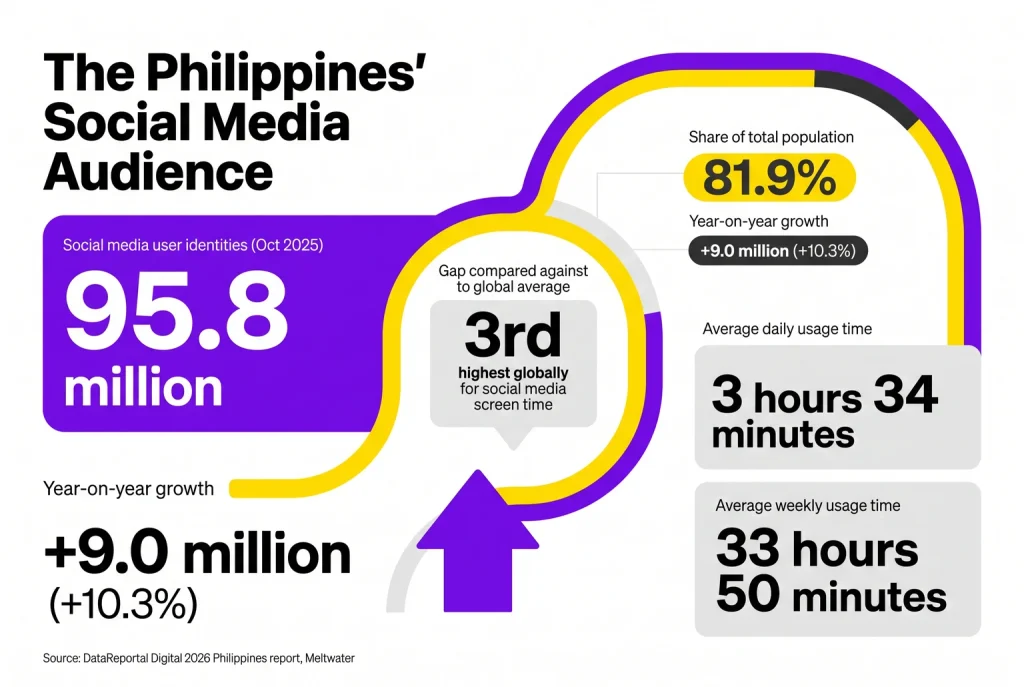
An audience that large and that active is expensive to ignore and easy to overspend on if you do not know what you are paying for. The sections ahead break down the pricing tiers, cost drivers, and evaluation criteria you need before requesting a quote from anyone, including us.
There is no fixed rate card for social media management in the Philippines, and any number you see, including the ones in this guide, should be treated as an estimate rather than a quote. Providers range from solo freelancers to boutique agencies to full-service outsourcing companies, and each structures pricing differently depending on who does the work and how much of it they cover.
The bigger driver is what is actually included in the package. A provider posting a few static graphics a week charges differently than one producing video content, managing ad spend, responding to comments and messages, coordinating influencers, and sending in-depth performance reports. Community management and engagement work, replies, moderation, ongoing conversation, tends to cost more than simple posting because it requires someone monitoring accounts daily, not just scheduling content in advance.
Seniority matters too. A package built around strategy, analytics, and campaign planning costs more than one built around basic execution, because you are paying for judgment, not just output.
Since actual quotes depend on scope, treat these as rough bands rather than a fixed rate card. Different sources land on different numbers, sometimes by a wide margin, which is itself a sign that “social media management” covers very different bundles of work.
Freelancers generally sit at the low end. Entry-level Filipino freelancers commonly charge ₱3,000 to ₱5,000 per client per month for basic scheduling and light engagement, while more experienced freelancers handling multiple platforms, ads, and reporting can reach ₱10,000 to ₱40,000 per month. Some advanced freelancers running full programs with analytics and strategy calls quote closer to ₱10,000 to ₱15,000+ per client.
Boutique agencies typically start where senior freelancers leave off. Small agency retainers can range from around ₱15,000 up to ₱80,000+ per month, with one pricing breakdown showing Starter tiers near ₱12,000–₱18,000, Growth tiers around ₱22,000–₱35,000, and Pro packages with video and paid ads climbing to ₱35,000–₱55,000.
Full-service agencies, the kind handling multi-platform content, paid social, influencer coordination, and deeper reporting, tend to sit higher. One 2026 pricing guide lists full-service packages at ₱60,000 to ₱150,000 per month, and enterprise-level retainers can exceed ₱100,000, sometimes reaching ₱200,000 to ₱300,000 for brands running integrated, multi-channel campaigns.
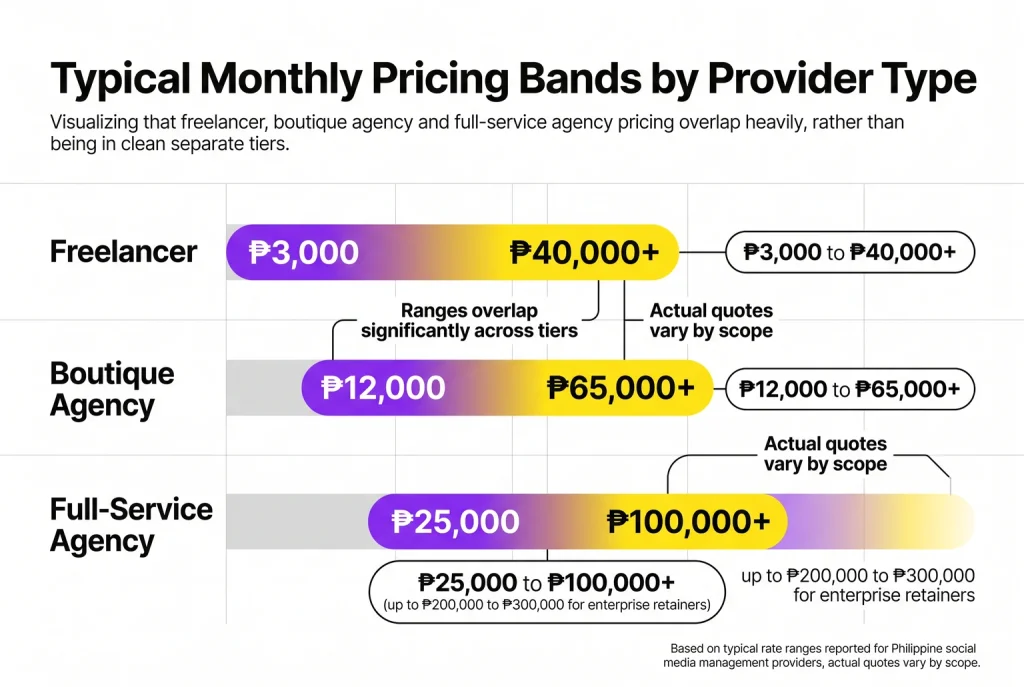
None of these figures are guaranteed quotes. Where a business lands within, or outside, these bands depends heavily on what’s actually included, which is what the next section breaks down.
The tier a provider quotes you is a starting point. What moves the number within, or beyond, that range comes down to a handful of scope decisions.
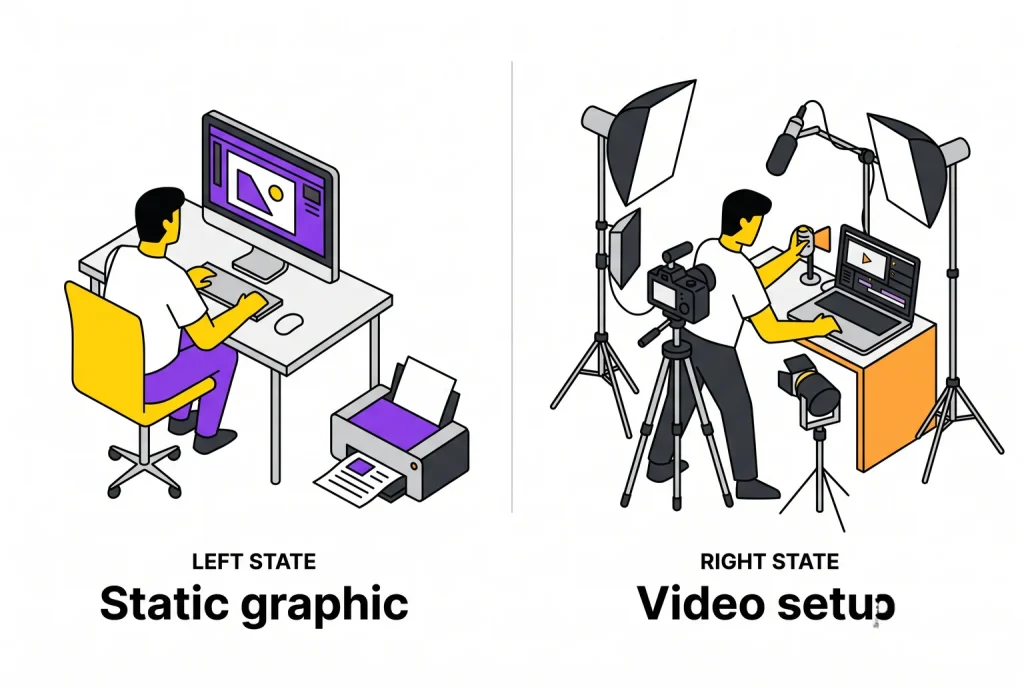
Each of these is a lever, not a fixed line item. A provider quoting low on platforms but high on video, or vice versa, isn’t necessarily overcharging. Ask what’s bundled before comparing two numbers side by side.
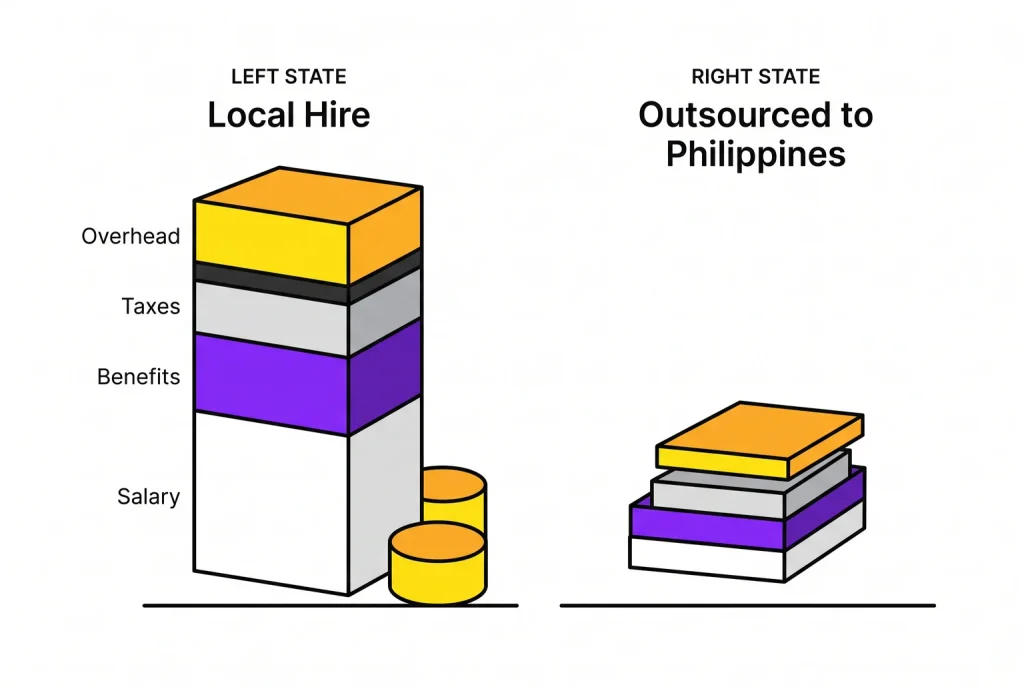
If you’re a founder or marketing lead outside the Philippines evaluating outsourcing, your goal is probably to keep quality high while cutting the overhead of a full-time local hire. The gap between those two costs is usually the whole argument.
US salary data alone shows why. ZipRecruiter puts the average social media manager salary at $64,845 a year, Robert Half’s 2026 range runs $62,500 to $95,500, and Salary.com reports a notably higher $100,490 to $124,350. In the UK, Indeed puts the average base salary at £34,418 a year. None of these figures include benefits, payroll taxes, office space, or management overhead, and there’s no reliable Australia figure to cite here, so treat this as directional rather than a full cost model.
Against that backdrop, outsourcing to Philippine-based providers commonly gets cited in the 50% to 70% savings range, with some estimates going as low as 40% or as high as 80-90% depending on scope and seniority. Those numbers come from a mix of agency marketing and third-party outsourcing guides, not a single audited benchmark, so a specific quote may land outside that band.
The savings case holds up better when paired with the market size argument from earlier: the Philippines had 95.8 million social media user identities as of late 2025, so PH-based talent isn’t just cheaper labor, it’s labor immersed in one of the platforms’ most active markets.
Before comparing quotes, get specific about what you’re trying to achieve: brand awareness, community building, lead generation, or direct sales, plus which platforms and what scope of work you actually need. A provider quoting you a flat number without asking these questions first is a warning sign.
Once you know your goals, evaluate providers on a few concrete points. Ask whether their proposal is a customized strategy tied to your KPIs or just a package based on post count. Request actual performance data from accounts they currently manage, not just a creative reel. Check their reporting cadence and whether they can explain how they track attribution back to business impact rather than leaning on likes and follower growth. Get clarity on what’s done in-house versus subcontracted, and get scope, deliverables, and ad spend separated clearly in the pricing itself.
Arc Innovation and Insights is one example of a full-service option built around this kind of process, combining strategy, content, community management, and analytics rather than selling posts by the dozen. Whether Arc or another provider fits, the right choice is the one whose scope and reporting match what you’re actually trying to move, not just the one with the lowest number on the quote.
Every range in this guide is a starting point for a conversation, not a rate card. Your actual cost depends on platforms, content mix, ad spend, and reporting needs specific to your business, and the only way to get a figure you can budget against is to lay those details out with a provider directly.
Arc Innovation and Insights takes this consultation-based approach: reach out through the Contact Us page or email social@arcinnovationph.com to talk through your goals and get a quote scoped to your platforms and workload. Whether you’re a PH SME watching every peso or an overseas brand comparing outsourcing options, that conversation is the fastest way to find out what your social media presence should actually cost.
Input your search keywords and press Enter.