
November 13, 2026
Picture a hypothetical Metro Manila skincare brand: five people, one phone on a tripod, maybe PHP 15,000 a month for marketing. The same 30-second clip goes to Instagram Reels, TikTok and YouTube Shorts on Friday. By the following Friday there are view counts on all three and no clear answer to whether any of it produced an order. That gap is where most small Philippine businesses stall, and this guide uses that illustrative skincare brand (a food brand in the same position would face the same choices) as its running example. It is not an Arc client case study.
Short-form video marketing means vertical clips, usually 15 to 60 seconds, made for fast viewing and shown in a feed that picks what to play next. A brand can show a product, answer a customer question and tell a small story before a viewer scrolls on.
The audience is already there. The Philippines had 98.0 million internet users in October 2025, and 97.7% of them used at least one social platform. In early 2025, 97.6% of Filipinos aged 16 and above watched online video weekly, against a 92.0% global benchmark. TikTok users in the country spent about 40 hours a month in the app as of early 2025.
Those figures describe reach, not revenue. Social media user identities, 95.8 million in October 2025, are not necessarily unique people, so treat them as directional. Big audiences on all three apps say nothing about which one will sell your serum or your sauce.
The sections ahead cover choosing a lead platform, a phone-based workflow for producing and distributing videos, paid boosting and creator partnerships, and measurement that ties views to orders.
The three apps reach different Philippine audiences and reward different things. The figures below are advertising audience estimates from late 2025, not monthly active users, and TikTok’s number counts only users aged 18 and above.
|
Instagram Reels |
TikTok |
YouTube Shorts |
|
|---|---|---|---|
|
Audience in the Philippines |
26.9 million Instagram users (22.9% of population); 58.8% of adult ad audience is female. Ad reach grew 24.6% in a year |
64.0 million users aged 18+ (81.8% of adults); 55.3% female |
59.6 million YouTube users (50.9% of population) |
|
Content style |
Polished, visual, lifestyle and beauty |
Casual, personality-led, trend-driven |
Search-friendly how-tos and explainers |
|
Discovery |
Followers plus recommendation |
Recommendation first |
Recommendation, with a path to long-form |
|
Commerce |
Link in bio, ads |
TikTok Shop, videos and livestreams tied to catalog |
YouTube Shopping |
|
Best fit |
Brand image, existing followers |
Direct sales, new audiences |
Education, evergreen content |
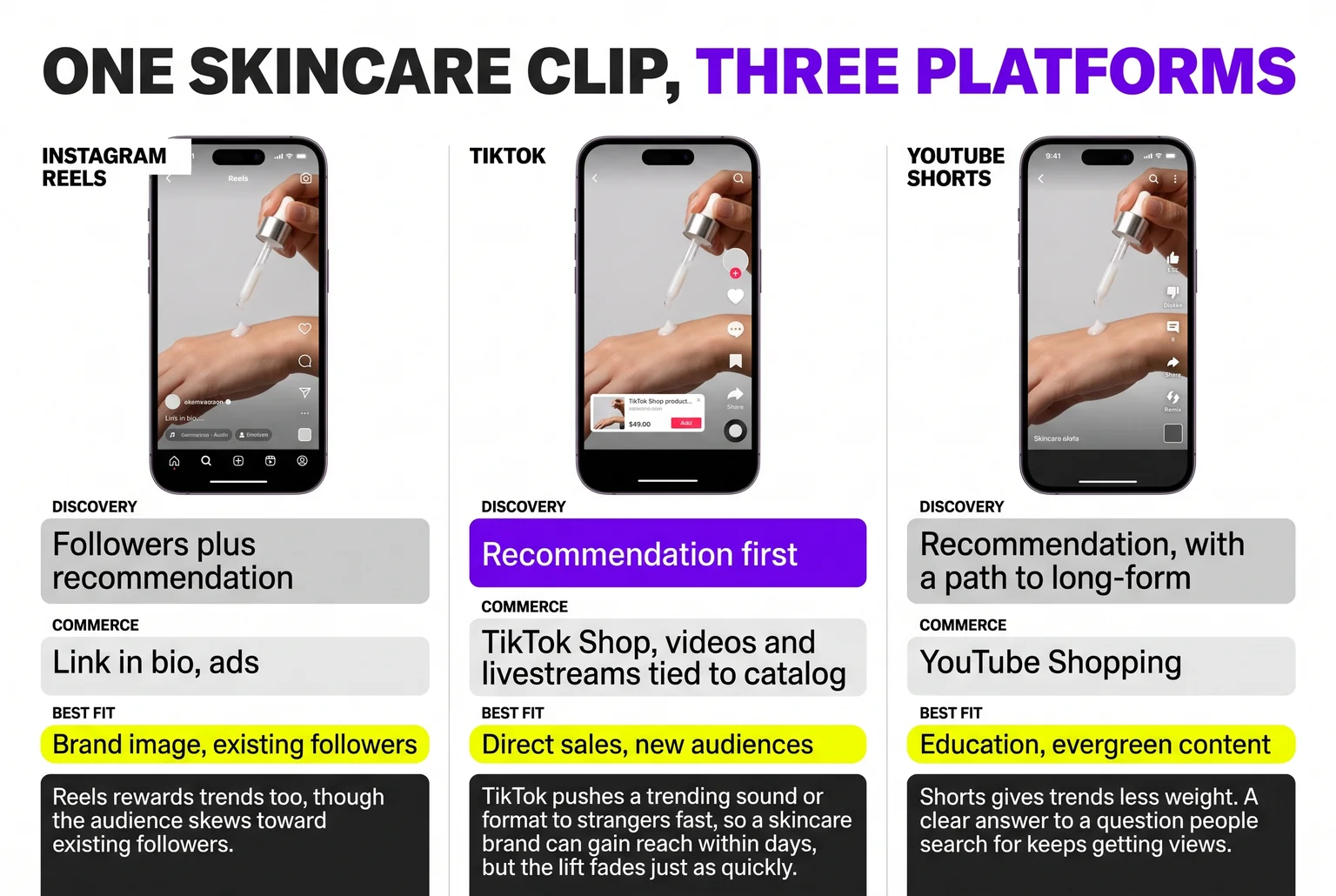
TikTok pushes a trending sound or format to strangers fast, so a skincare brand can gain reach within days, but the lift fades just as quickly. Reels rewards trends too, though the audience skews toward existing followers. Shorts gives trends less weight. A clear answer to a question people search for keeps getting views for months.
Lead with TikTok for the running example. A skincare or food brand sells a low-ticket product by showing it, and TikTok Shop connects the video to a catalog listing. Registration is free, but sellers must complete verification. Review generally takes up to seven days, and a business may need its BIR Certificate of Registration (Form 2303). Commission is calculated on the item price after seller discounts, excluding shipping, and is deducted after delivery and buyer acceptance. Transaction and shipping-program fees can come on top, so check current rates in Seller Center before pricing products.
Make Reels secondary, since it suits brand image and existing followers. Shorts comes third for now. A Short over one minute can be blocked by an active Content ID claim on its music, so use rights-cleared audio.
This ranking suits a brand selling a simple product to adults. A high-consideration service, or customers who mostly use Instagram, may justify a different order.
A hook is the opening second or two that gives a viewer a reason to stay. Completion rate, the share of viewers who watch to the end, is the number to watch, because views include people who left after one second. TikTok’s guidance says to use the first 3 to 6 seconds to hook viewers and deliver value, and its Creative Codes material reports that the first six seconds capture 90% of ad-recall impact. No study backs a precise “three-second” rule, so check each platform’s retention graph for a sharp early drop.
For the running skincare brand, good hooks show the result first, ask a question customers actually send, state a specific problem (“Oily by lunchtime in Manila heat?”), or open mid-action with the product in hand.
Keep awareness clips to 15 to 30 seconds. TikTok describes 21 to 34 seconds as best for most ads, and explanations can run to 60.
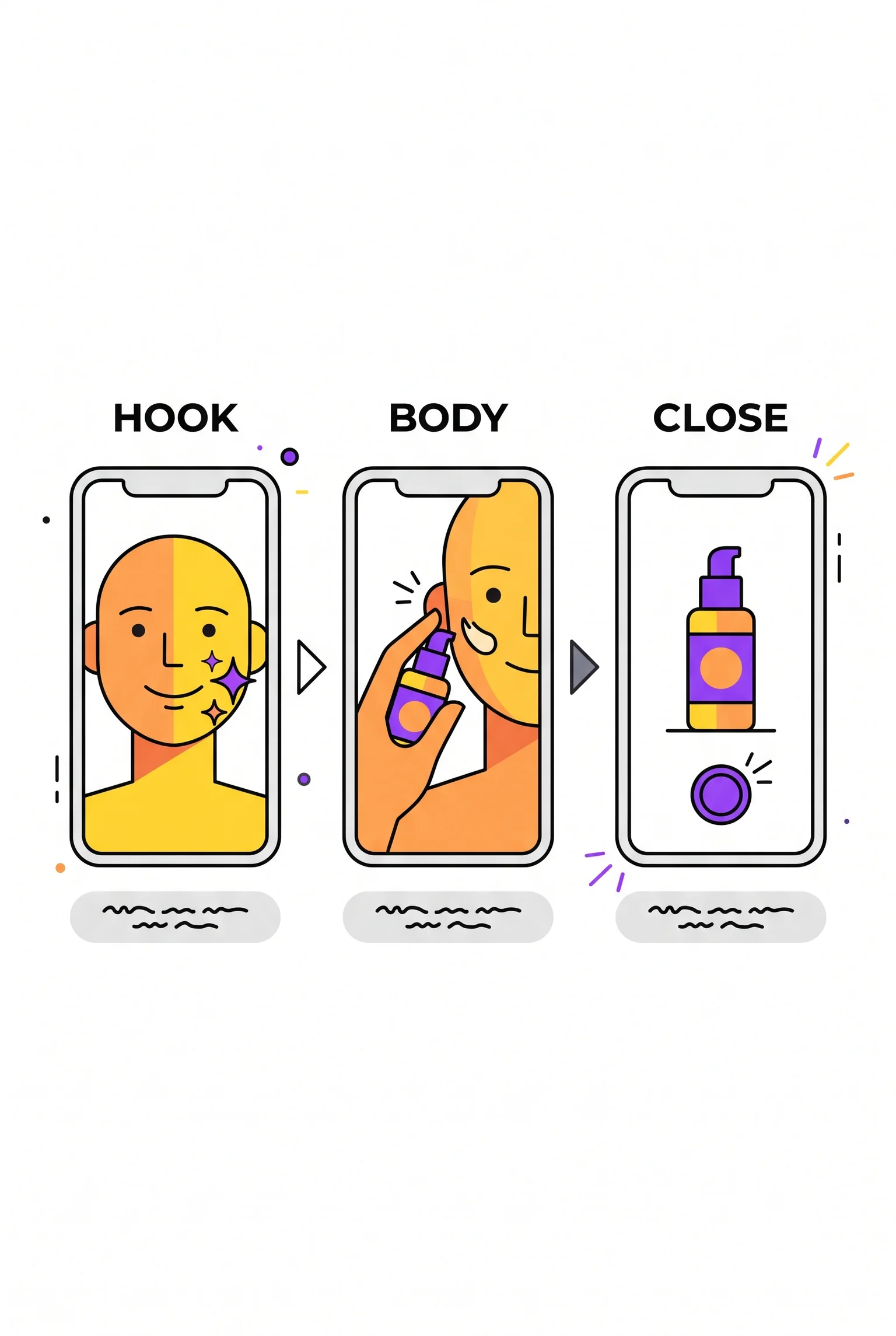
Structure each clip as hook, body, close. Change the visual or on-screen text every few seconds, and caption everything, since many people watch without sound.
Three concepts for the brand:
Use a trend only when it supports the product story. TikTok advises adopting trending sounds or formats only when they reinforce the product story while keeping your own identity. If a trend forces the product into it, skip it.
Your small team can film once and publish three times each week. The running skincare brand uses this cycle to produce five videos weekly.
|
Tool |
Use |
Cost |
|---|---|---|
|
CapCut |
Editing, auto-captions |
Standard is free. Pro is US$19.99 a month or US$179.99 a year, so check the in-app price in pesos |
|
InShot |
Editing, multilingual auto-captions |
Tagalog support isn’t listed on its site |
Watermarked exports carry another app’s logo, so export without one before posting. Reposting an unchanged file also ignores platform differences. Change the hook, caption wording, text placement and call to action for each platform. A TikTok version might open on the question, while the Reels version opens on the result.
If your team lacks time or equipment, video production support can cover filming.
Paid promotion is a test, and you scale it only after a video earns it. A common mistake is paying for content creation and budgeting nothing for promotion, though a small budget can still give a good video a start. Pick videos that already hold viewers, then give each one a goal tied to leads or sales.
On Instagram, boost an existing Reel in the app or run a Reels campaign in Ads Manager. Ads Manager offers objectives such as awareness, traffic, engagement, leads and sales. Boosting is quicker, while Ads Manager gives more control over the goal.
On TikTok, Spark Ads promote an existing post and keep its likes and comments. They can use your own posts or creator posts the creator has authorized for ads, and authorization codes can expire. You choose an objective such as traffic, conversions, lead generation or sales.
The running skincare brand can start with a simple structure. Take its two best organic videos and run each as its own ad with one objective, sales. Use the same audience and budget for both, and leave them running for the same number of days. Keep the winner and retire the other.
For budget, set aside a fixed slice of the monthly marketing money before you plan content, perhaps a small test on each platform. Do not scale until a video produces orders at a cost your margin can cover. Judge results by purchases, qualified leads and return on ad spend, since views alone will not pay for the next month’s ads.
Match the creator type to the goal. Established creators give reach and social proof, micro-creators bring niche relevance, and UGC creators make native-style videos you can run as paid ads. In a 2026 dataset of 208 Philippine Instagram creators, median engagement was 5.54% for nano creators (1,000 to 10,000 followers) and 2.30% for micro creators (10,000 to 100,000). Smaller accounts engage more but reach fewer people.
Before signing anyone, check where their audience lives and how old it is, how their videos typically perform, whether past posts are brand safe, and whether their language and style suit your product. Our influencer marketing service covers this vetting.
A short brief should cover: – the one action viewers should take – the claims the creator may and may not make – required hooks, tags and disclosure wording – deliverables, deadline and revisions – written permission to use the video as an ad
Disclosure should be immediately visible and understandable, not hidden after “more”. Testimonials must come from real experience, and they cannot replace substantiation for product claims.
Two Philippine campaigns show different uses. Jollibee’s #JolliEverAfter ran nine sub-challenges with In-Feed Ads, and TikTok reports 8 million views in 48 hours and 50,000 new followers. That is a large-brand, participation-led approach. Unilever ran creator “before-and-after” videos as Video Shopping Ads on TikTok Shop and recorded a 20% relative lift in initiated checkouts and 17% in purchases. For a skincare brand, that proof-style content with a buy button is the closer fit.
Views show distribution, not business impact, so report attention, clicks, conversions and revenue separately. KPIs fit into three funnel stages: awareness, engagement and conversion. One benchmark suggests a view-through rate above 60% for videos under 60 seconds, though it varies by platform, audience and objective.
|
KPI |
Decision it drives |
|---|---|
|
Reach, watch time |
Keep or drop the topic |
|
Completion rate |
Rewrite the hook or shorten the video |
|
Shares, saves |
Make more of the same angle |
|
Profile or link clicks |
Fix the call to action |
|
Leads, orders, CPA |
Move budget between platforms |
Give every link its own UTM parameters per platform, creator and video, for example utm_source=tiktok&utm_medium=organic&utm_campaign=summer_sale&utm_content=creator01_video03. GA4 then reports sessions, leads, orders and revenue by those tags. Install the Meta Pixel (with Conversions API if possible) and the TikTok Pixel so paid results are recorded.
Many Filipino customers order through Messenger or Viber, so add what links cannot see. Give each creator a discount code, and ask “How did you find us?” at checkout. If your site isn’t recording orders properly, a site built for inquiries and sales comes first.
In a hypothetical month, the skincare brand spends PHP 20,000 on creator fees, boosting and editing, and tracked orders bring PHP 60,000 in revenue. ROAS (attributed revenue divided by spend) is 3.0. ROI uses profit: at a 50% contribution margin, profit is PHP 30,000, minus the PHP 20,000 cost, divided by 20,000, gives 50%.
The monthly report should list each platform, creator and video with spend, reach, completion rate, clicks, leads, orders, CPA, ROI and the next action.
Short-form video runs on a weekly cycle: plan, film and edit, post, answer comments and messages, test paid budget on the winners, then report against orders. Most small teams in the Philippines can sustain it for a few weeks before something slips.
At Arc Innovation and Insights, we offer social media management that covers:
Frequency, platform mix and reporting depend on the package, so ask about monthly video counts, approvals, creator costs and contract terms before signing.
We work from an entrepreneurial standpoint, so reports tie back to inquiries, orders and return on spend. An account manager gives a business without an in-house team one point of contact.
Contact us to discuss a short-form video plan for your business.
Input your search keywords and press Enter.